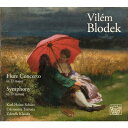
【輸入盤】 ブロデック、ヴィレム(1834-1874) / Flute Concerto, Symphony : Karl-Heinz Schutz(Fl) Zdenek Klauda / L'Armonia Terrena 【CD】
[ ショップ名 ] HMV&BOOKS online 1号店
[ 現在価格 ] 3744 円 (税込)
[ PRポイント ]
[ 商品説明 ]
出荷目安の詳細はこちら商品説明VILEM BLODEK:Concerto for Flute & Orchestra D MajorSymphony D MinorKarl-Heinz Schutz, fluteL'Armonia Terrena orchestraZdenek Klauda, conductorThe personality of Vilem Blodek (1834?1874) is known today almost exclusively among flutists. This is due to his brilliant Flute Concerto, which unquestionably stands out from the standard music of its time. The work is significant not only as one of the few early Romantic concertos for this instrument, but also because its scope and conception reveal the expertise of a virtuoso flutist. Blodek was deeply familiar with the full range of the flute’s capabilities, showcasing it to its fullest while avoiding excessive physical demands on the soloist in the pursuit of compositional ambition. In short, it is an impressive concerto that, despite its virtuosity, surpasses the typical works of that era’s composer-virtuosos in its compositional depth.Yet, to the broader public, the name of this Czech composer, flute virtuoso, and music educator has been almost forgotten. Even his once popular and frequently performed opera “V studni” (“In the Well”) has faded over time. Due to the simplicity of its libretto and the overall naivete of the piece, it has virtually disappeared from the repertoires of many opera houses, only occasionally appearing in student productions because of its accessibility both musically and vocally. Nevertheless, in his own time, Blodek was a widely performed and respected composer, largely due to his many stage works written for theatrical productions.In an effort to honor the still somewhat hidden creative genius of Vilem Blodek, we present his grand “Symphony in D minor”, which confidently enters the realm of Romantic symphonism. This Symphony is a magnificent, expansive composition of extraordinary melodic beauty and accomplished craftsmanship. Particularly noteworthy is Blodek’s imaginative, colorful, and masterfully executed orchestration, in which he naturally emphasizes the woodwind harmony. Blodek’s meticulous work with musical motifs and themes would not have been out of place even for composers like Felix Mendelssohn-Bartholdy or Robert Schumann. Blodek’s music is deeply emotional. It speaks directly to its performers and almost dictates the manner of its interpretation. One can hear clearly in his music the influence of his opera and theatrical experience. It has the rare quality of painting vivid images; it often feels as though it is telling a story or enhancing a theatrical or cinematic scene. Yet, it never falls into cheap descriptiveness, avoiding Romantic cliches such as frequent tremolos or broken, diminished chords. Drawing from the classical, Beethovenian tradition of thematic and motivic development, Blodek’s music delineates the contours of various musical landscapes. Through these contrasts, he effectively creates the dramaturgy of the entire work. The symphony moves from the darkly intense music in the home minor key, through winding paths, to the cathartic, victorious D major resolution in the final “Allegro”. In short, the journey of this symphony could be summed up with the Latin phrase “Per aspera ad astra” (through hardships to the stars). Yet, the composer himself provides us with a poetic clue, inscribed on the title page of the score, revealing what inspired him and what he sought to express through his music.Another motivation for releasing this disc, which you are now holding in your hands, is the original version of the Flute Concerto in D major, presented here, newly revising the solo part and its original Romantic orchestration, thus receiving its world premiere. The only regret we must truly feel is that a nervous illness prematurely ended Blodek’s creative career, and subsequently, his life. It would have been immensely interesting to see where the talent of such an exceptional composer as Blodek would have taken him and what fruits his creative efforts would have borne. Nevertheless, Blodek remains one of the outstanding figures of his time, and this recording aims to complete another piece of the mosaic of Czech musical Romanticism, which would not be complete without him.